
- More than 3500 articles
- More than 20 years of experience & expertise
- We have the widest range of off road products
- Ordered today before 3 p.m. shipped the same day
Car Parts
- gararge tools
- Axles & Suspension
- Car Protection
- Fixing material
- Fuel system
- Car Care
- Chassis & Body
- Diagnostic tools
- Electrical
- Exterior
- Filters
- Interior
- Cooling System
- Clutch
- Air intake
- Air compressor
- Engine
- Gaskets
- Brakes
- Service kit
- Hoses and Pipes
- Steering distribution
- Exhaust systems
- Wheels
- Heat & Air Conditioning
Car type
Brand
Price
Sensor
Sensors play a crucial role in your car's electronic systems. Whether you are a passionate off-road adventurer or simply enjoy daily driving, at Roan4x4 we understand the importance of reliable sensors that optimise the performance and safety of your vehicle. That's why we offer high-quality sensors that meet the stringent requirements of modern cars.






Sensor
WHY ARE RELIABLE SENSORS IMPORTANT?
Sensors act as your car's senses. They detect different parameters and conditions and relay this information to the electronic system. Reliable sensors ensure that your car receives correct readings, improving performance, fuel efficiency and safety. They play a vital role in controlling the engine, monitoring exhaust gas, measuring tyre pressure and much more.
DIFFERENT TYPES OF SENSORS
At Roan4x4, we understand that every car is unique and requires specific sensors. Therefore, we offer a wide range of high-quality sensors suitable for various vehicles and applications. Here are some of the popular options we offer:
Wheel speed sensor (ABS sensor)
The wheel speed sensor, also known as ABS sensor, is located in the wheels and is part of the ABS system. These sensors determine when to trigger the ABS system. Almost all cars have ABS, which blocks the wheels when braking. This allows you to continue driving the car while braking fully, even on a slippery road, for example. Some brands and models use a single sensor on one wheel for the speed signal. Some vehicles put an anti-lock braking system use wheel speed and transmission output to determine faults.
See also Braking systems for ABS sensors.
Crankshaft sensor in camshaft sensor
Two of the car sensors at engine parts are the crankshaft sensor and camshaft sensor, which are located at the crankshaft and camshaft. These two sensors are often mentioned in the same breath because they both tremble in the engine. The engine is driven by the crankshaft and camshaft. The sensors located here pay attention to the position of the camshaft and crankshaft and then transmit this to the ECU. At the crankshaft, the sensor on the position of the valves shows the position of the pistons. The crankshaft sensor looks at the position of the piston. With this information, the ECU controls ignition and injection.
MAP sensor
The intake manifold of an engine may be fitted with a MAP sensor. This sensor puts of absolute pressure in the intake manifold. This is a pressure sensor that can be mounted on the intake manifold or connected externally. A MAP sensor is an active sensor and, partly for this reason, a very sensitive part of the car.
Impulse sender flywheel
The impulse sender is also one of the car sensors, obviously part of the flywheel. The flywheel is attached to the engine by the crankshaft and ensures that the drive is transmitted from the cylinders in an even treatment without jerks. The clutch plate is connected to the flywheel, so it rotates with the flywheel. When you shift gears, van clutch plate is taken off the flywheel, removing drive. Then from clutch plate comes back against the flywheel.
Knock sensor
A knock sensor, also known as a pinging sensor, detects the knocking that can occur in a brewing engine. Said is also known as pinging in can cause the ignition signal in the cylinder to be set so far to ‘’late‘’ that the combustion is no longer correct. This knocking produces sound vibrations that have a certain wavelength. The knock sensor is basically a microphone that picks up these sound vibrations. The signals from this sensor go to the control device, which then assigns to the right cylinder and ensures that action is taken. This can be various things, such as reducing the fuel supply, changing the timing of ignition or by reducing the turbo pressure. Without a knock sensor, a petrol engine can suffer serious damage.
Oil pressure sensor
A pressure sensor is a common sensor in cars. The oil pressure sensor is one of them. This sensor simply meets the oil pressure in the car. Oil pressure is of great importance for any engine, so it is also a warning system on motorbikes. When the oil pressure drops below a certain level, which is measured by the oil pressure sensor, a light comes on on your dashboard.
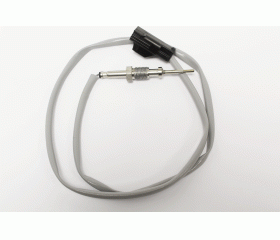
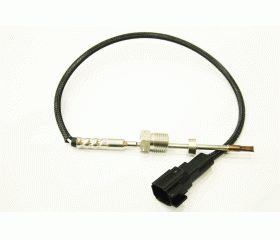
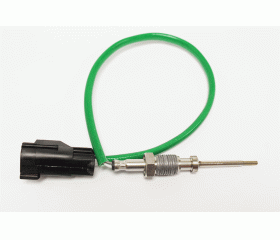
Temperature sensor
The temperature sensor assists fuel management in recording the engine's operating temperature. The injection timing and ignition angle can be adjusted according to engine conditions. This is controlled by the control unit, based on information from the temperature sensor.
Lambda sensor
A lambda sensor measures the proportion of oxygen in the exhaust gas. Said is passed to from ECU, as it is with most car sensors. The lambda sensor provides information about the gas mixture coming out of the engine. Depending on these values, it adjusts the mixture, adding more fuel or air to make combustion optimal. Only petrol vehicles are equipped with a lambda sensor. All vehicles built after the year 2000 have a second lambda sensor, which sits behind the catalytic converter and monitors its effectiveness and operation.
Air massameter
The air masseter is located between the air filter housing and the intake manifold. All the air drawn in passes this auto sensor. If it is an atmospheric engine, the air is drawn in by the negative pressure in the cylinder. If your engine is turbocharged, the air is drawn in by the compressor wheel. The air masseter measures the amount of air entering the engine. Based on this data, among others, the amount of fuel to be injected can be determined.
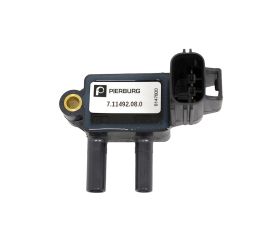
Exhaust gas pressure sensor
The exhaust gas pressure sensor, one of the pressure sensors in a car, has a simple operation. It measures the pressure in the exhaust system, before the particulate filter. If the pressure exceeds a certain limit, this sensor signals to the computer that there is a problem. If so, it is usually the case that either the particulate filter is clogged, or the pipes running to the sensor have become clogged.
Accelerator pedal position sensor
The accelerator pedal position sensor detects the position of the accelerator pedal and transmits this data to the car's computer. From there, it then opens the throttle valve to let air into the intake, based on information from the throttle position sensor. This allows you to accelerate, for example. Only cars with electronic throttle control have this sensor.
Parking sensors
Parking sensors are probably the best-known car sensors; everyone has heard of them. Parking sensors simply tell you when you're about to hit something, so you can park more easily and won't get damaged. These kinds of sensors, which detect the position of your car relative to other vehicles and objects, come in more and more forms these days. For example, you also have lane assist, which make sure you always stay safely within your lane.